

Global
AI on the Ballot, Around the World
The questions AI puts on the ballot are not only American. Explore our country coverage below. Our deepest coverage is the United States, state by state.
United States · State By State
Where AI is on the Ballot in 2026
The following state briefs are drawn from the recorded episodes of AI on the Ballot. They are draft content for infographics. Every figure traces to the cited episode. Please verify all figures and candidate details against primary sources before publishing.
California
The Battle for Regulation in California and New York
2 States
California and New York serve as the primary state-level comparative models for legislative action versus federal inaction.
100%
State-Level Preemption Defense- Both Democratic and Republican governors remain fully aligned on defending state sovereignty against federal preemption attempts.
79%
Americans express little to no confidence in tech platforms to prevent automated misinformation, aligning with calls for binding legislation over voluntary corporate pledges.
485 Terawatt-Hours
Global Consumption- Worldwide data center power demand reached roughly 485 TWh annually, matching the total electricity consumption of Germany and driving up residential utility costs
What is Happening?
Hosts Sanjay Puri and Bennett Iorio launched a timely series titled AI on the Ballot. Guests here are Roy Austin Jr., Director, Howard Law Artificial Intelligence Initiative, and Miranda Nazzaro, Senior Tech Reporter, The Hill. They examine how artificial intelligence shapes elections across the United States. The hosts stress that Congress has passed zero federal AI laws. However, this rapidly changing technology is greatly affecting the lives of Americans. The computer servers consume large amounts of energy from local power grids. This has caused a rise in electricity bills by the utility companies. Simultaneously, there is an imminent fear of job losses. Corporate executives once claimed that smart software would only assist human workers. Instead, corporate layoffs show algorithms replacing staff across various major sectors. New graduates have found it difficult to secure regular employment opportunities. Moreover, artificial media and propaganda are being spread through popular social networking sites. Deceptive articles confuse voters during vital campaign seasons. The hosts will track these urgent issues across twenty weeks of broadcast coverage. They plan to interview governors, lawmakers, and policy specialists about these growing challenges.
Regulations: Who Controls the Technology?
Both hosts explore the intense national struggle over artificial intelligence policies. Federal authorities frequently attempt to override individual state laws. However, governors from both political parties firmly protect their local rights. State leaders insist on safeguarding residents from digital harm. Guest Miranda Nazzaro, a senior technology reporter, explains this evolving legal battle. She notes that neither side will secure total control over current rules. Lawmakers must accept pragmatic compromises on several major bills before Congress. Bipartisan agreement exists around child safety and basic cybersecurity standards. In contrast, sharp party divisions remain regarding content moderation and diversity initiatives. Overseas, European governments enforce strict legal guardrails on technology corporations. Conversely, Washington officials reject sweeping limits to protect commercial tech dominance. Federal officials often announce voluntary industry pledges right before elections. These official statements try to reassure anxious voters without slowing corporate progress. Therefore, full federal laws have been held up in gridlock.
Why Are Voters So Frustrated?
Guest Roy Austin explains the major reasons behind rising public outrage. Austin highlights voter anger over expensive electric utility bills. Huge corporate data hubs consume enormous power supplies across many states. This relentless energy demand forces families to pay higher monthly living costs. Public pushback often compels technology firms to cancel planned facility construction. In addition, students openly boo industry speakers at university events. Fresh graduates cannot easily secure entry-level programming or legal research positions. Automated models draft simple contracts and generate software code independently. Therefore, large companies reduce classic apprenticeship opportunities. Extreme wealth concentration also fuels intense public backlash. Tremendous financial capital flows to a tiny group of industry executives. The citizens see tech billionaires putting money into the political campaigns. The citizens feel that corporate greed is taking over public security.
What Questions Should Voters Ask?
Both featured guests advise voters to challenge political candidates directly. Roy Austin urges citizens to question candidates about family financial security. Voters should demand specific plans that protect jobs from rapid automation. Candidates must prove they take rapid technological shifts seriously. Miranda Nazzaro suggests framing voter questions around the protection of children. She recommends asking politicians how families can use digital tools safely. This personal approach forces leaders to bypass rehearsed talking points. Candidates have to be empathetic rather than speaking jargon that has no meaning. Also, elected officials should address the increase in energy costs and misinformation online. Future elections will determine how technology will be governed. Hosts Sanjay Puri and Bennett Iorio encourage citizens to demand real answers. Informed voters must choose leaders who truly comprehend this modern digital transformation.
Maine
The Regulatory Battles in Maine and Colorado
30+
States have introduced hundreds of legislative bills addressing AI this year alone.
100%
Identical operational behavior is exhibited by digital algorithms across every single state line.
1
Statewide complete ban on data center construction was enacted by Maine due to power grid strain.
50
Conflicting state regulatory frameworks could emerge, creating compliance burdens for small innovators.
What is Happening?
Hosts Bennett Iorio and Sanjay Puri explore how AI shapes the upcoming midterm elections with two eminent guests. They are Wendell Wallach, Emeritus Chair of Technology and Ethics Studies, Yale Interdisciplinary Center of Bioethics, and Eric Goldman, Professor at the Santa Clara University School of Law. Maine recently banned data center construction across the entire state. Lawmakers worry about massive strain on local electrical power grids. Other regions, including Denver, Colorado, enforce similar strict building halts. These giant facilities consume as much energy as small cities. Utility companies pass these rising power costs directly to everyday households. Meanwhile, automated tools actively displace lower-wage workers in critical battleground states. Many voters now consume news rewritten and filtered by opaque algorithms. Unchecked machine systems quietly alter political beliefs across America. Technology corporations decide which perspectives citizens actually see online. Consequently, artificial intelligence has become a central voter issue this year.
Regulation
Federal officials and state leaders wage an open war over regulatory control. Washington wants a uniform national policy to support business innovation. In contrast, individual states demand the right to protect local consumers. Over thirty states have introduced hundreds of legislative bills this year alone. Legal expert Eric Goldman explains why states rush to regulate technology. He compares this legal struggle to early internet battles over Section 230. Goldman warns that fifty conflicting state laws harm smaller software entrepreneurs. Giant technology firms can afford complex compliance, but small startups cannot. Furthermore, Goldman rejects the idea that state acts as useful testing grounds here. He argues that digital algorithms function identically across every single state line. Broad federal rules could protect innovators while demanding responsible user education.
Energy Demands and Economic Realities
Guest Wendell Wallach examines the severe environmental burdens created by digital hubs. He highlights how massive computing clusters devour electric power and clean water. Wallach disputes corporate claims about achieving artificial general intelligence through pure scaling. He questions whether massive energy consumption truly delivers proportional societal benefits. Tech corporations build hundreds of power-hungry campuses across states like Texas. These projects expand corporate power without lowering carbon footprints. Furthermore, Wallach rejects the notion of an unavoidable conflict with China. He warns politicians against adopting reckless Cold War rhetoric. Instead, corporate lobbyists use geopolitical fear to block necessary consumer safeguards. Both political parties often surrender to the seductive cult of endless innovation. Wallach urges voters to challenge these unchecked corporate infrastructure expansions.
Voter Deception and Information Integrity
The hosts and their guests confront the dangerous spread of synthetic election media. Both guests observe that artificial intelligence creates highly convincing political disinformation. Wallach warns that unchecked deepfakes directly threaten democratic decision-making. He proposes mandatory visual labels on every synthetic campaign advertisement. Furthermore, he recommends stiff financial fines for deliberate deceptive political media. Media literacy and voter education must accompany strong legal rules. Eric Goldman notes that generative tools will always make factual errors. Therefore, users must verify machine outputs before sharing questionable claims. Legal liability might fall on individuals who amplify dangerous digital falsehoods. Clear accountability protects voters from widespread confusion during heated electoral contests. Without basic transparency, public trust in democratic institutions quickly collapses.
The Road Ahead for Voters
Bennett Iorio and Sanjay Puri outline the choices facing American citizens this November. The next Congress will write permanent rules for artificial intelligence governance. Voters must hold candidates accountable for skyrocketing utility bills. Workers deserve clear answers about job retraining and automation safeguards. Next, the hosts will travel to Colorado to question actual political contenders. Colorado previously passed landmark technology rules, but federal pressure dismantled the measure. Now, voters in Colorado face massive projected utility rate hikes from local computing centers. Citizens must demand leaders who prioritize public welfare over corporate profits. Practical technology governance requires transparent rules, secure energy grids, and human dignity.
Colorado
Energy Demands and Policy Battles in Colorado
56
Massive computer campuses are housed by Colorado currently, with plans for more.
50
Distinct state regulatory frameworks threatens commercial tech stability compared to a unified federal standard.
55%
Is the projected surge in Colorado household electric bills by 2029, driven by the intense energy and cooling demands of expanding AI data center campuses.
15
Full time human software developers were required before modern algorithms started generating complete codebases.
What is Happening?
Hosts Bennett Iorio and Sanjay Puri launched the third episode of AI on the Ballot. They interviewed State Senator Mark Baisley, who represents Colorado’s fourth Senate District. The conversation centered on data centers, rising power rates, job security, and digital election risks. Colorado currently houses 56 massive computer campuses, and developers plan many more. State utility regulators warn that household electric bills could surge 55% by 2029. Massive cooling systems and high-powered computer processors consume enormous amounts of public energy. Two legislative efforts to manage these surging electrical costs recently collapsed. As a result, Colorado faces serious economic challenges ahead of the November gubernatorial race. The next governor will appoint utility commissioners. And they will decide whether to limit future facility expansion. Furthermore, AI now touches every aspect of civic life across the Centennial State.
Regulation
Senator Baisley strongly criticized Colorado’s initial landmark artificial intelligence bill from 2024. He called that historic civil rights statute poorly drafted and unfairly restrictive. State officials required technology companies to submit raw source code to the attorney general. Tech developers pushed back fiercely against surrendering valuable trade secrets to state bureaucrats. Consequently, the legislature repealed the contentious law under pressure from national leaders and business groups. Baisley favors using standard civil rights laws. He believes it will stop discrimination in housing, loans, and admissions. He authored alternative model legislation. It applies traditional nondiscrimination rules directly to automated systems. Baisley argues that national lawmakers must craft uniform federal standards. A patchwork of fifty distinct state frameworks could drive companies to better regions. The senator believes sensible federal policies will deliver stability. And it will foster commercial growth nationwide.
Energy Infrastructure and Fair Utility Rates
Baisley addressed growing community frustration regarding rising residential power bills across the state. He argues that utility providers must not penalize tech companies just for building data centers. However, data facilities should pay for the unique local infrastructure upgrades they create. The senator believes families should never finance corporate transmission lines or extra substation costs. He expressed strong optimism regarding private sector solutions for growing power generation needs. Energy developers are already constructing small nuclear reactors near commercial properties in advance. These self-contained power sources will feed regional grids before major data centers arrive. Private industry will supply necessary megawatts without burdening municipal electrical systems. Baisley welcomes this free-market approach to solving the regional energy crisis. Thoughtful infrastructure investments will power the state economy while protecting working-class family finances.
Workforce Realities and Economic Evolution
The discussion shifted toward rapid labor displacement caused by smart generative software. Baisley acknowledged that automation reduces employee headcounts. Algorithms now generate complete codebases that once required fifteen full-time human software developers. However, the senator insists that historical technological disruptions eventually create new commercial opportunities. He opposes government intervention in commercial markets. He even opposes urging politicians to stay out of private enterprise. Employers must instead honor a basic social contract by offering severance runways and tuition assistance. Meanwhile, public colleges and trade schools must coordinate closely with nearby employers. Schools must align curriculum goals with actual job requirements across emerging technical fields. Baisley highlights Colorado’s growing quantum computing sector as an ideal career for displaced staff. Embracing advanced technology will ultimately maintain American leadership across the modern global economy.
Protecting Democratic Elections and Voting Systems
Baisley addressed the grave dangers that deceptive digital tools pose to modern democracy. He called for mandatory disclosure labels on all synthetic political media and campaign ads. Fabricated audio, deceptive campaign videos, and youth exploitation demand civil and criminal punishments. Moreover, the senator voiced strong suspicions about proprietary code inside electronic voting equipment. He argued that vote-counting machinery performs basic math. It requires simple, fully open-source code. Opaque operating systems with millions of lines of code invite deep voter distrust. Therefore, state governments must ensure complete transparency on election night. Baisley noted that regular constituents rarely discuss automated tech in their daily political conversations. Nevertheless, public leaders must safeguard democratic processes. That too before automated deception undermines basic civic trust.
Ohio
Ohio at the Crossroads: How the AI Boom Is Shaping the 2026 Midterms
200+
Large data centers are currently operating across Ohio as computing hubs expand rapidly.
0
State-level laws currently govern artificial intelligence systems or machine learning within Ohio.
$1,000,000,000
Invested locally by tech hyperscalers like Amazon into data infrastructure.
1000
Blue-collar households are facing mounting energy bill pressures driven by grid-intensive computing facilities.
What is Happening
Hosts Bennett Iorio and Sanjay Puri host the AI on the Ballot podcast series. Their show streams across the Regulating AI and GIE Foundation platforms. They welcome guest US Representative Greg Landsman from Ohio’s 1st Congressional District to discuss technology. Ohio has rapidly grown into a massive national hub for computing power and data centers. Ohio is home to well over two hundred large data centers, and many more are on their way. Companies such as Amazon invest billions in huge local infrastructure projects. At the same time, big political figures run around the state campaigning in Senate and gubernatorial races. Candidates debate how these automated technologies directly influence local jobs and electricity rates. Rising energy bills from computer grids worry thousands of everyday blue-collar families. Therefore, Ohio serves as an essential bellwether for the future of national tech governance.
Regulation
Ohio currently maintains zero state-level laws regarding artificial intelligence systems and machine learning. Rep. Landsman harshly denounces local politicians for making huge tax breaks for tech companies. Landsman calls for an immediate stoppage of all these non-disclosure agreements. Tech companies have to bear the cost of their own power supply and water usage and clean up the environment. In addition to that, Landsman is lobbying for federal laws. He dismisses informal voluntary pledges from the White House as mere weak handshake agreements. Instead, binding federal statutes must hold multi-billion-dollar corporations fully accountable for their burdens. National rules must prevent local communities from issuing hasty bans on vital infrastructure. The federal government must lead decisively. It will help in innovating tools to develop without harming citizens.
Workforce Protections and Employment Realities
The rapid rise of automated systems directly threatens Ohio’s traditional manufacturing and automotive base. Both hosts and Landsman emphasize that productive work provides essential dignity. Corporate executives should not casually celebrate job displacement under the false banner of efficiency. Automation now endangers both blue-collar plant workers and white-collar professional careers alike. Companies reduce essential entry-level jobs, student internships, and apprenticeships. This narrow-minded recruitment practice fails to provide youngsters with necessary training and opportunities for advancement. The government needs to engage the labor unions, businesses, and policymakers in order to protect the workers. Society must protect hardworking citizens rather than leave displaced employees to struggle alone.
Information Integrity and Election Security
Artificial intelligence systems now aggressively reshape the broader political information environment across America. Nearly half of the voting public consumes daily news filtered through large language models. Opaque algorithm choices dictate what information citizens actually read during heated election cycles. Furthermore, political groups recently circulated deceptive deepfake campaign videos in Ohio without clear disclosure. Landsman argues that extreme electoral manipulation produces an uncaring legislature. And that ignores critical digital protections. Wealthy tech donors leverage immense financial resources to influence high-stakes political campaigns. Landsman proposes establishing a dedicated Department of Technology. It must be modeled after the Food and Drug Administration. Independent public inspectors must review automated models and monitor post-training operations for safety. Transparent technical oversight protects everyday democratic institutions from weaponized digital disinformation.
A Decisive Election for National Governance
The upcoming midterm elections place Ohio voters at the center of federal policymaking. Voters will elect leaders who directly shape federal statutes like the Great American AI Act. The winning candidates will decide whether states retain regulatory power or yield to federal preemption. Landsman urges voters to ask every candidate whether they truly support working families. Candidates must explain practical steps for defending jobs, energy costs, and personal safety. The hosts highlight the immense stakes facing both Ohio workers and the broader American public. National leaders cannot treat technology disruptions as merely academic or distant corporate concerns. Every citizen must understand how automated decisions impact their community and family budget. Voters will ultimately determine who governs this powerful technological transformation in November.
Washington
Federal AI Policy: The Battle Between States and Washington
99%
Senate (in a 99-to-1 vote) voted against federal preemption of state-level rules.
3
Key regulatory sectors requiring agency-specific AI oversight under Rep. Ted Lieu’s framework are healthcare, finance, and aviation.
3
Essential drivers of technological innovation identified by Professor Aziz Huq are technical talent, vibrant research environments, and venture investment.
100%
Human control is championed in proposed bipartisan rules concerning automated nuclear weapons systems.
What is Happening
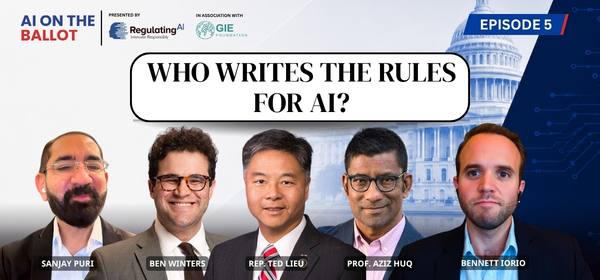
Hosts Bennett Iorio and Sanjay Puri examine federal artificial intelligence policy on AI on the Ballot. Their show streams across the Regulating AI and GIE Foundation platforms. They invite Representative Ted Lieu, legal scholar Aziz Huq, and consumer advocate Ben Winters. Even after a 99-to-1 Senate vote against federal preemption, states face heavy federal pressure. Colorado recently suspended its landmark consumer safety statute following sharp federal interventions. On the other hand, there is a rising problem of increasing utility bills. This is because of energy-consuming computer data centers in the local population. Therefore, voters demand clear accountability from technology leaders and elected officials alike.
Regulation
Representative Ted Lieu warns that Congress has passed zero comprehensive federal technology statutes. He co-chairs a congressional commission that designs targeted safety policies for machine systems. Lieu argues distinct agencies must regulate separate applications across healthcare, finance, and aviation. He specifically champions bipartisan rules. These rules require meaningful human control over automated nuclear weapons. Meanwhile, the administration attempts to block local state laws without offering federal protections. Lieu supports national standards but insists Washington must never leave a regulatory vacuum. Furthermore, local governments hold the authority to accept or reject massive data facilities. Federal lawmakers must enforce strict transparency rather than letting algorithms operate without supervision.
Constitutional Limits and Geopolitical Realities
Professor Aziz Huq analyzes the constitutional boundaries between state authority and federal dominance. He explains that states possess clear legal rights to protect local citizens from commercial harms. Individual jurisdictions successfully target specific harms like nonconsensual digital likenesses and deceptive election media. Moreover, Huq rejects the common notion. That is, regulations have the effect of stifling innovation. Innovation relies on talented technicians, a vibrant research environment, and investment through ventures. Smaller firms can adapt and succeed even within fragmented regional markets. Huq also questions aggressive geopolitical arguments regarding an inevitable technology conflict with China. True national security depends on broad economic productivity rather than mere corporate deregulation. Citizens can shape future tech policies directly through local state initiatives and tort litigation.
Consumer Harms and Economic Inequity
Ben Winters outlines the serious economic vulnerabilities that confront everyday consumers across America. Automated software now influences a lot of aspects. This includes vital decisions about medical claims, employment interviews, and bank loans. Furthermore, surveillance pricing mechanisms secretly harvest user data to raise prices on goods. Large-scale computing centers also affect electricity supply systems by demanding increased power charges from the public. As Winters notes, multibillion-dollar tech firms invest large sums of money in order not to be held accountable for their actions. It is easy for scammers to use text generation services cheaply to commit fraud. Tech giants often claim that simple transparency requirements will destroy valuable commercial innovation. Winters contends that true development requires ground rules to safeguard the weak families. The government bodies need to actively punish such companies. This will restrict their rash behavior to safeguard the economy from suffering.
Empowering the Informed Voter
The hosts emphasize that AI directly influences modern election integrity and public debate. Deceptive synthetic audio and fabricated videos regularly confuse voters across major social platforms. Winters suggests that tech firms and election administrators make the disclosures in the media explicit. Besides, rich corporate sponsors give lots of money to influence the federal legislation. Rep. Lieu asks ordinary citizens to write to their congressmen about their concerns. Working people must describe the implications of technological change for their occupation and neighborhood. By participating in local democracy, voters can properly protect themselves from corporate excesses.